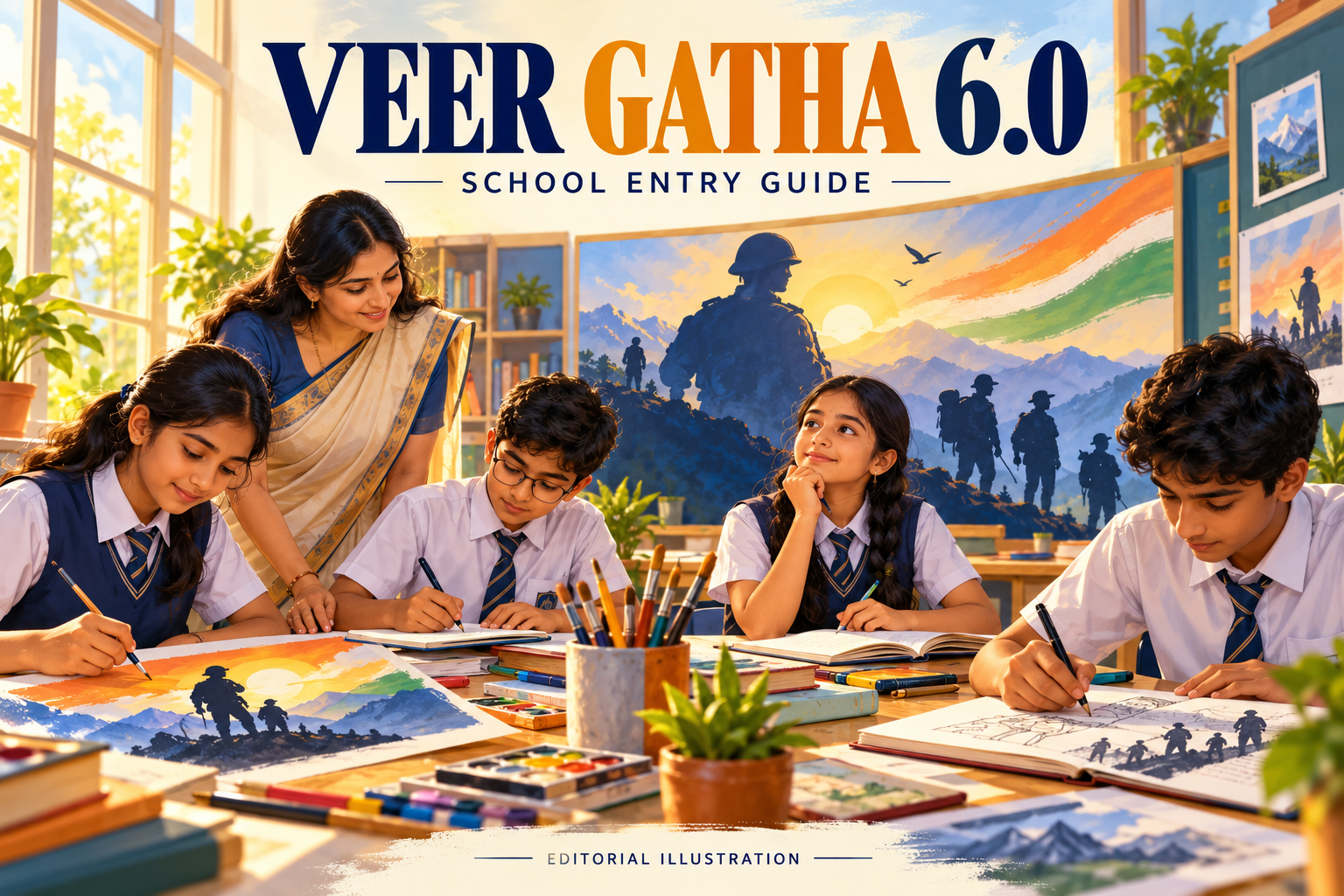
Veer Gatha 6.0 school submissions are open until 31 October 2026 on the official MyGov project page. The school evaluates student work and uploads selected entries; participation should not be confused with every student independently uploading a national-level submission.
The official project page sets out the categories, activities and evaluation stages. CBSE Academic also displays the extended 31 October submission date.
Veer Gatha 6.0: category and format checks
The formats below are also described in CBSE Circular 58/2026. Check the official instructions for the medium you choose.
| Grade group | Written format shown in the project guidance | Other listed options |
|---|---|---|
| Grades 3–5 | Paragraph: 150 words | Poem, painting or drawing |
| Grades 6–8 | Paragraph: 300 words | Poem, art, multimedia or short video |
| Grades 9–12 | Essay: 750 words | Poem, art, multimedia or short video |
Read the complete activity guidance before choosing a format. The project connects creative work with gallantry awardees and inspiring warriors, rather than asking students simply to copy a biography.
Confirm who is handling the school upload
For a school covering all the grades, the guidance provides four selected entries: one for Grades 3–5, one for Grades 6–8, one for Grades 9–10 and one for Grades 11–12. Schools ending at Grades 5, 8 or 10 have specific allocation instructions on the project page.
A useful first step is to identify the teacher or coordinator responsible for collecting, reviewing and uploading the entries. Students and parents should confirm their school’s internal deadline, which needs to allow time for the school’s selection and submission process.
Keep a shared school checklist showing the student, grade group, chosen format, review status and upload responsibility. This is an editorial organizational suggestion, not a replacement for the fields and requirements of the official portal.
Research a subject before creating the project
The project page points schools to the Gallantry Awards portal and an NCERT publication on Param Vir Chakra awardees. Use those references to verify names, actions and context before building a creative response.
Make a short evidence note with the source, the fact it supports and the idea the student wants to express. This makes it easier to distinguish a verified event from an imagined scene or an unsupported claim found in a forwarded message.
Then choose one clear connection between the subject and the student’s own reflection. A focused account of a value, decision or act of courage can be easier to develop meaningfully than a long sequence of dates with little explanation.
Keep quotations visibly separate from the student’s own writing and record where they came from. Do not turn an invented sentence into something attributed to a real awardee merely because it sounds inspirational.
Review the work without replacing the student’s voice
Teachers and parents can ask questions, help check facts and point out an unclear passage. The student should still be able to explain the choice of subject, the creative decisions and the meaning of the finished work.
One helpful review is to ask the student to describe the project aloud in a few sentences. If the written piece uses language or claims they cannot explain, return to the draft and establish what they actually want to say.
For a visual or multimedia entry, check that the main message remains clear when someone sees it without a spoken explanation. Test that captions can be read, narration can be heard and the final file opens on the device used for review.
Prepare the final file and upload evidence
Use a clear filename that identifies the school’s working category and version without exposing unnecessary student information. Keep the original working file separately from the final file chosen for submission.
Before uploading, compare the selected entry with the details the coordinator intends to enter. A correct project attached to the wrong student or grade group creates a different problem from a creative weakness in the work itself.
Our critical-thinking exercises offer a related way to practice separating claims, evidence and personal interpretation. That habit helps students produce a response they understand and can discuss.
Finish the school process before the deadline
After the upload, retain the acknowledgement or available submission evidence in the school’s private records. Do not assume that saving a file on a teacher’s computer is the same as completing the portal submission.
Follow the official project page for later evaluation information. Selection for an award is a separate outcome; this guide does not promise that a submitted or shortlisted entry will win.
Official sources checked on 29 October 2026. The featured image is an AI-generated editorial illustration, not an actual participating school or submitted student project.