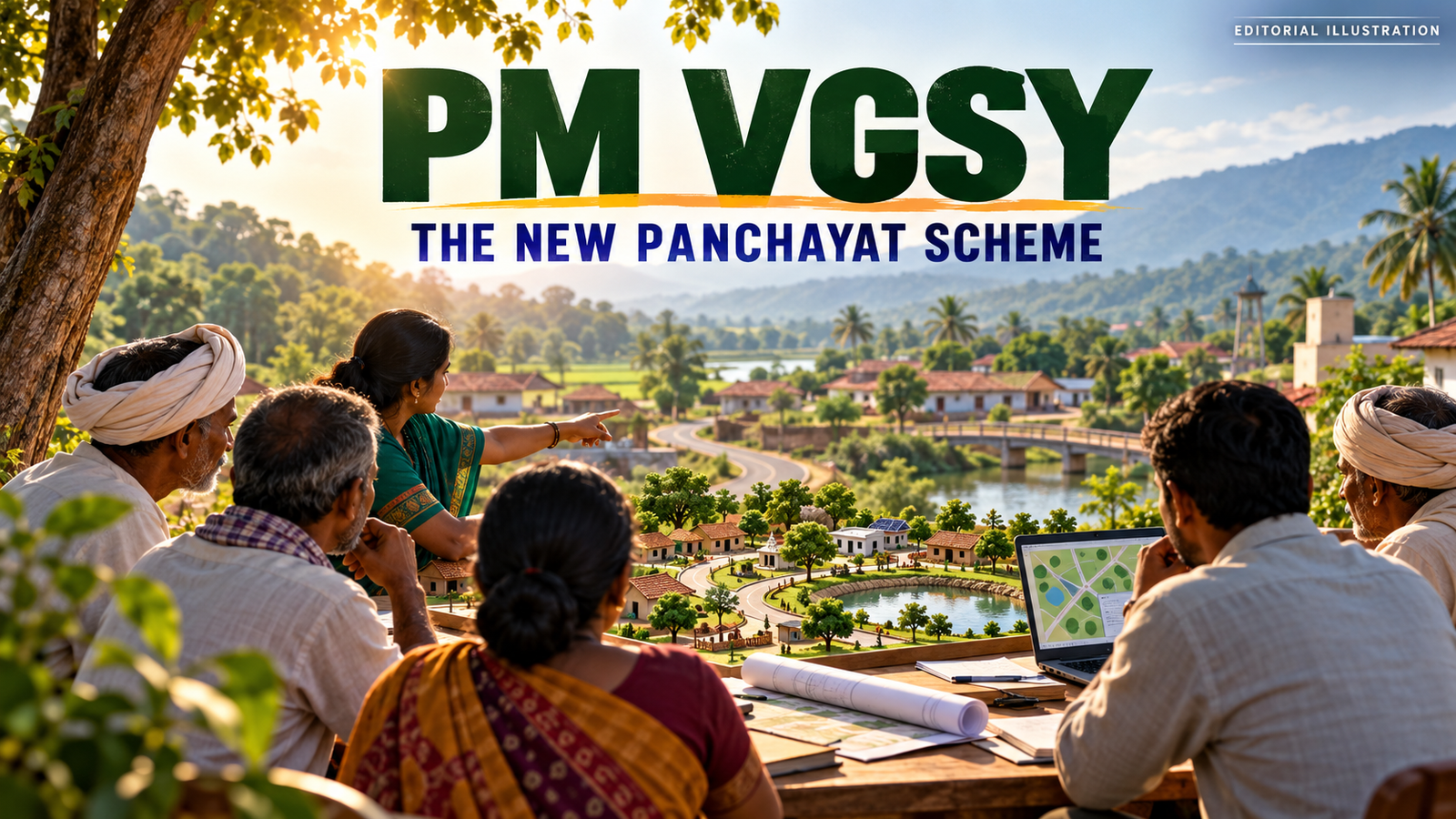
PM VGSY, the Pradhan Mantri Viksit Gram Swaraj Yojana, was approved by the Cabinet on 28 October 2026 for 2026–27 to 2030–31. The scheme focuses on Panchayat governance, planning and capacity. Its announced budget should not be interpreted as a uniform cash payment available to every household.
Reviewed 28 October 2026 against the Cabinet release and NIC’s description of existing Panchayat digital systems.
PM VGSY: the announced essentials
| Item | Cabinet announcement |
|---|---|
| Programme | Pradhan Mantri Viksit Gram Swaraj Yojana |
| Type | Centrally Sponsored Scheme |
| Approved period | 2026–27 to 2030–31 |
| Total outlay | ₹7,395.55 crore |
| Core focus | Local governance and planning capacity |
The official Cabinet release describes coordination of village priorities, government interventions and resources. It also explicitly says the scheme creates no permanent posts, while allowing possible need-based contractual support within its institutional arrangements.
That is an important distinction for readers encountering a forwarded claim about mass permanent recruitment. A real engagement would need its own authorised notice and conditions.
Understand the planning purpose
A village can have several priorities competing for attention: maintenance, access, public assets or service gaps. A planning process needs to identify the problem, the relevant responsibility and the available resources.
A programme that strengthens that process is different from a standalone household-benefit scheme. The individual services discussed in a local plan may still operate through their own departmental rules.
When assessing a claim, ask what the announcement actually authorises. Do not infer a personal entitlement from the size of a national programme budget.
See how the existing digital tools fit
NIC’s eGramSwaraj description identifies planning, progress reporting, accounting and an asset directory among its functions. It also describes integration with AuditOnline.
These functions help explain the distinction between a proposed activity, an approved activity and a record of progress or expenditure. Each answers a different question about local development.
The Cabinet announcement builds on existing systems. It should not be described as proof that every promised new function is already available in every Panchayat’s public view.
Ask concrete questions about a local priority
The following worksheet is an editorial suggestion for making a development question specific. It is not an official application form.
| Planning question | Useful information |
|---|---|
| What is the problem? | Location, affected service and observable issue |
| Who is responsible? | Relevant local body or department |
| What is proposed? | A defined activity or intervention |
| What resources are identified? | Applicable programme or funding source |
| What would show progress? | A measurable stage or completed result |
For example, “the access path beside this public facility becomes unusable after rain” is more specific than a request for development in general. Evidence about the location and conditions can make the issue easier to discuss.
Keep personal beneficiary details out of public posts unless there is a clear reason and appropriate authority to share them. A service problem can often be explained without publishing a household’s private records.
Do not confuse a plan with completed delivery
A proposed activity is not evidence that work has started. A recorded allocation is also different from a completed asset or verified service improvement.
Look for the stage, period and relevant record when discussing progress. If the information is incomplete, state the missing piece rather than filling it with an assumption.
Our critical-thinking guide explains how to separate a claim from the evidence supporting it. The same habit is useful when reading local-development announcements.
Check forwarded application and recruitment claims
The Cabinet release reviewed here is not a universal household-registration invitation. It also does not establish that a payment to an unknown intermediary will secure a benefit or job.
Ask for the issuing authority, current notice and programme-specific instructions. If a message instead demands an immediate payment without those details, verify it through an established official channel.
Our guide to checking suspicious messages offers a separate method for examining the message itself.
Follow implementation at the right level
The practical next step is to watch for state and local implementation instructions and the relevant planning or disclosure records. Keep the scheme’s governance purpose attached when sharing its name.
A useful public discussion identifies the local need, the responsible institution and the evidence of progress. That is a more reliable basis for participation than assuming a national approval automatically produces an individual payment.
Featured image: AI-generated editorial illustration, not an official document, app screenshot or photograph of an actual event.