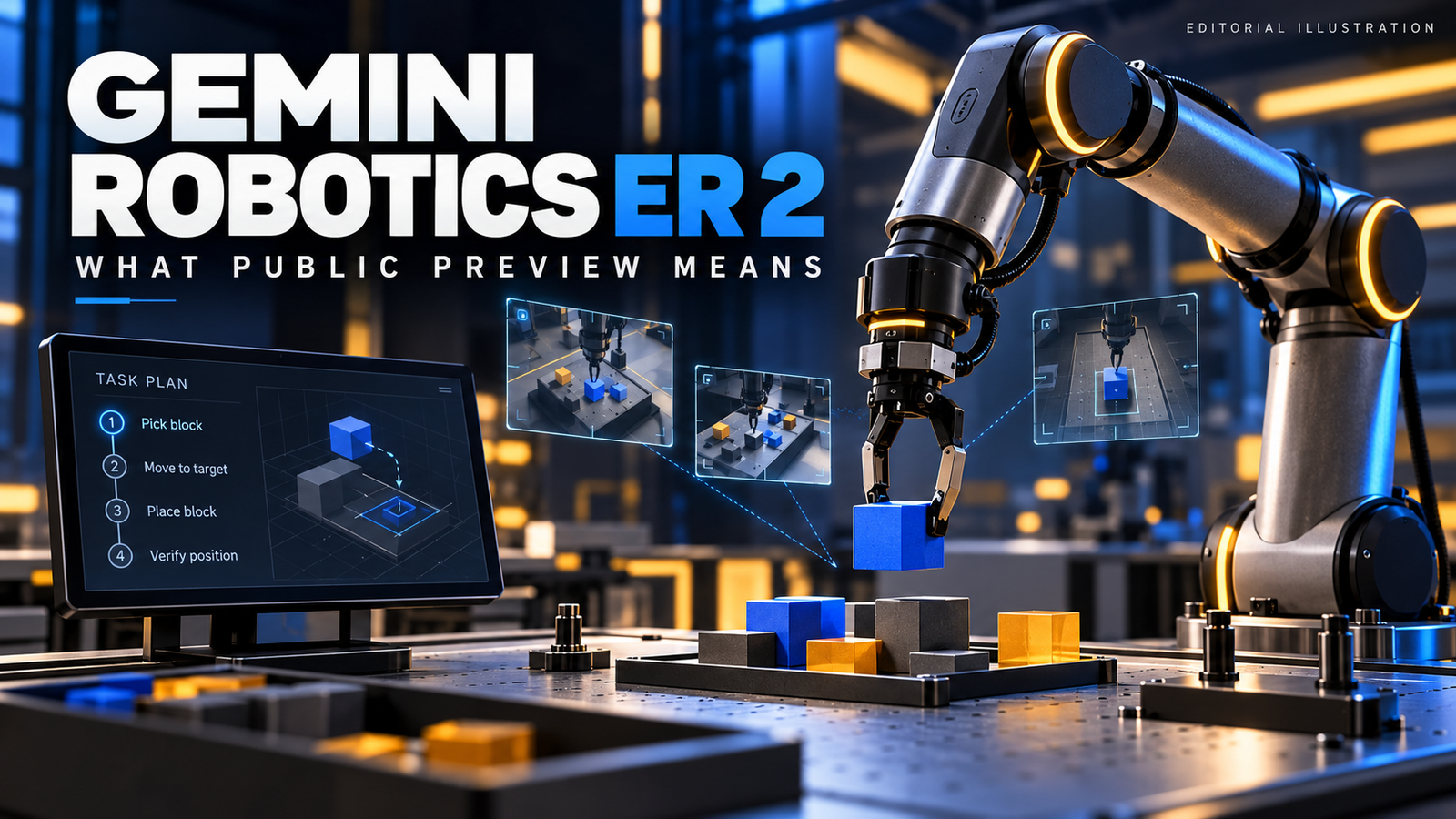
Gemini Robotics ER 2 became available in public preview on Google’s enterprise platform on 27 October 2026. The model helps interpret a robot’s surroundings and plan tasks. It should be assessed as a reasoning component within a larger robotics system, rather than as proof that any connected robot can safely perform any job.
Reviewed 28 October 2026 against Google’s announcement and developer documentation. No independent hardware benchmark is claimed.
Gemini Robotics ER 2: what Google announced
Google’s Cloud launch article describes spatial understanding, video interpretation, task-progress assessment and orchestration of tools such as navigation or lower-level action interfaces.
The current model documentation identifies the model as gemini-robotics-er-2-preview. It labels the offering Preview and directs users to the applicable pre-general-availability terms.
Those details establish the available model and launch stage. They do not independently establish the reliability of a particular factory, laboratory or warehouse integration.
Separate task reasoning from physical control
A robot can need several decisions before moving: identify the target, choose the next step and decide whether the previous step succeeded. It also needs systems that translate permitted actions into actual motion.
Google’s announcement describes developers exposing lower-level controls as tools. That makes the interface between the model and the machine an important part of evaluation.
| Layer | Question for an integration review |
|---|---|
| Perception and reasoning | Did the system understand the scene and instruction? |
| Task planning | Is the proposed sequence appropriate? |
| Tool interface | Are the requested actions supported and bounded? |
| Physical execution | Did the machine complete the permitted action? |
| Verification | Is the success claim supported by observation? |
The table is our explanatory framework, not a reproduction of Google’s architecture diagram. It helps identify which part of a demonstration produced the result.
Start with one narrowly defined task
A useful pilot has an observable goal and a clear stopping point. For example, a team might evaluate whether an object is correctly identified and whether a task’s completion is recognised in recorded video.
Define the test conditions before collecting results. Keep a record of object types, camera arrangement, lighting, instructions and any human intervention.
That makes comparisons more useful than showing only a successful clip. A repeatable test can reveal which changes improve performance and which simply make the task easier.
Measure failures as well as successful steps
Record incomplete attempts, incorrect success claims and occasions when a human intervenes. Decide in advance how each will appear in the evaluation.
A model that recognises uncertainty may require a different operational response from one that confidently labels an unfinished task complete. Both cases matter when designing the surrounding workflow.
Do not transfer a vendor’s benchmark percentage into your own expected success rate. The tested task, data and conditions must support that comparison.
Read preview conditions before committing a deployment
The documentation explains that preview features can have limited support and are subject to specific terms. Review the current agreement, service availability and support arrangements for the planned use.
A pilot decision should also account for the surrounding hardware, integration work and ongoing evaluation. Model availability is only one part of the system’s practical cost and readiness.
| Pilot decision | Evidence to request |
|---|---|
| Supported use | Current model documentation and applicable terms |
| Integration effort | Defined interfaces and engineering responsibilities |
| Operating limits | Conditions under which the workflow will stop |
| Evaluation | Repeatable tests and a failure log |
| Maintenance | Process for assessing later model or system changes |
These are suggested review questions, not a claim that every organisation needs the same deployment plan.
Keep this launch distinct from other robotics stories
Our Google–NASA robotics article covers a separate proof-of-concept research announcement. Similar themes around AI and physical tasks do not mean the projects use interchangeable systems or share deployment status.
For a broader discussion of permissions and workflow boundaries, see using AI agents in a small business. Physical robotics adds its own hardware and operating-context questions.
Move from an announcement to a measured pilot
The useful next step is to define a task, read the current documentation and identify the evidence needed for a pilot decision. Keep the vendor’s stated capabilities separate from results measured in your own environment.
Public preview creates an opportunity to explore the model. Readiness for a particular operation still needs to be established through the complete system and its intended conditions.
Featured image: AI-generated editorial illustration, not an official document, app screenshot or photograph of an actual event.