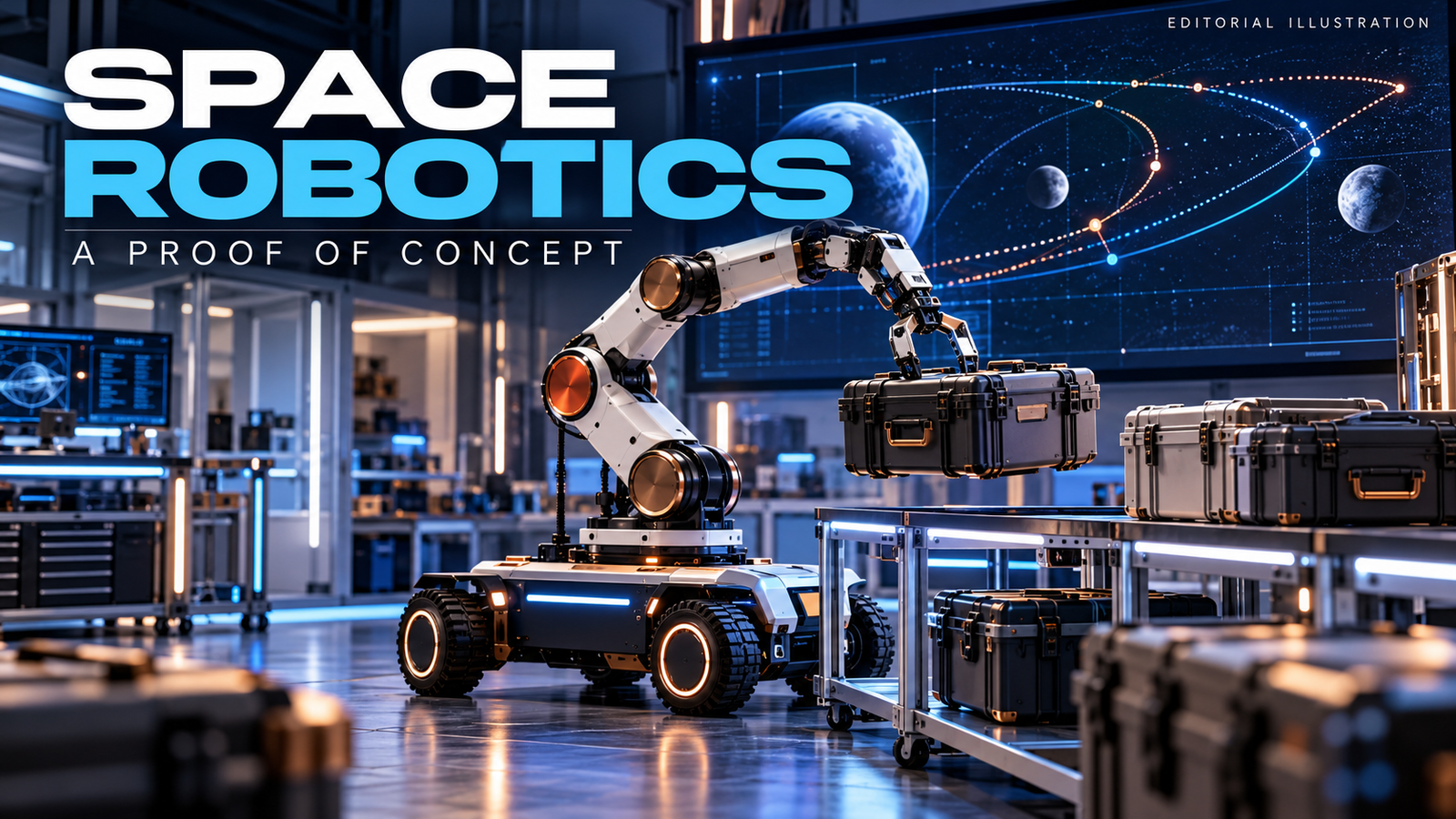
The Google NASA robot announcement describes a proof-of-concept research system, not a robot already deployed on Mars. Google Public Sector’s 27 October update outlines work with NASA teams on a machine intended to assist future crews with equipment and logistics. The distinction matters when judging claims about what space AI can do now.
Published 28 October 2026. This article analyses the announced research; it does not report an independent hardware test.
Google NASA robot: what was demonstrated
Google describes a laboratory pick-and-place task involving a medical bag. The work uses simulation and vision-language-action modelling to connect instructions, visual information and physical movement. Read Google Cloud’s research update.
The intended role includes handling equipment so that people can focus on other tasks. The source presents human supervision as part of the goal; it does not establish an autonomous medical practitioner or a certified operational spacecraft system.
A demonstration is useful evidence of progress on its tested task. It still needs to be read alongside the setting, constraints and remaining evaluation.
Why local computing matters to this research
Google’s update describes training models using cloud resources and operating fine-tuned models on compact edge devices. That separates development infrastructure from the hardware doing work near a future crew.
In general engineering terms, local execution can reduce dependence on a live connection for every step. It does not automatically establish that the complete system works safely through every failure or disruption.
For a reader comparing AI announcements, ask two questions: where was the model trained, and where does it run during the task? Those answers can be different without contradicting each other.
Separate a test result from a mission capability
The checklist below is our suggested way to read robotics claims. It is not a NASA certification process or a claim that this project has passed each item.
| Evidence question | Why it matters |
|---|---|
| What task was tested? | A narrow task does not establish general capability |
| What environment was used? | A laboratory is different from an operational mission |
| What human help was allowed? | Intervention changes how autonomy should be described |
| How were failures counted? | A result needs a defined measurement |
| What remains untested? | Limits help identify the next useful experiment |
A robot can successfully move an object under one arrangement while requiring more testing under another. Reporting the arrangement is therefore part of explaining the result.
Avoid turning an impressive demonstration into a claim about an entire future mission. That would require evidence about the wider system, operating conditions and approval process.
Questions a useful follow-up should answer
A future technical update would be more informative if it explains the range of objects, lighting conditions and task variations evaluated. Readers should also look for how the system responds when it cannot complete an instruction.
Ask whether a human can recognise a failure and intervene effectively. A description of the intended supervision is not the same as a measured evaluation of every recovery procedure.
These are proposed evaluation questions. This article does not claim the researchers failed them, or imply that the announcement supplies answers it does not contain.
Keep equipment support distinct from medical advice
The research includes possible support for handling medical equipment. That is a different role from deciding a diagnosis or treatment.
Google’s earlier account of the Crew Medical Officer Digital Assistant describes a separate clinical decision-support proof of concept. The two projects should not be collapsed into one claim that a robot can replace a human medical officer.
This article discusses the engineering announcement. It does not offer medical instructions or claim that an experimental system is available for public healthcare use.
Read this alongside other AI demonstrations
The same distinction between a model, a demonstration and a deployed service applies outside space research. Our technology-claims guide sets out questions for checking those stages.
For an education example, Google Polar Peaks uses a simulation to teach AI reasoning. A learning simulation and a physical robotics demonstration have different purposes, so their results should not be treated as interchangeable.
Watch for the next measured milestone
The useful next development is evidence of what the system can repeatedly do, under which conditions and with what oversight. A deployment date should come from a verified programme announcement rather than an inference from a laboratory video.
For now, the report supports a narrower and still interesting story: researchers are testing how AI and local computing might assist future crews with physical tasks. Keep that scope intact when sharing the headline.
Featured image: AI-generated editorial illustration, not a photograph of an actual event, product or test.