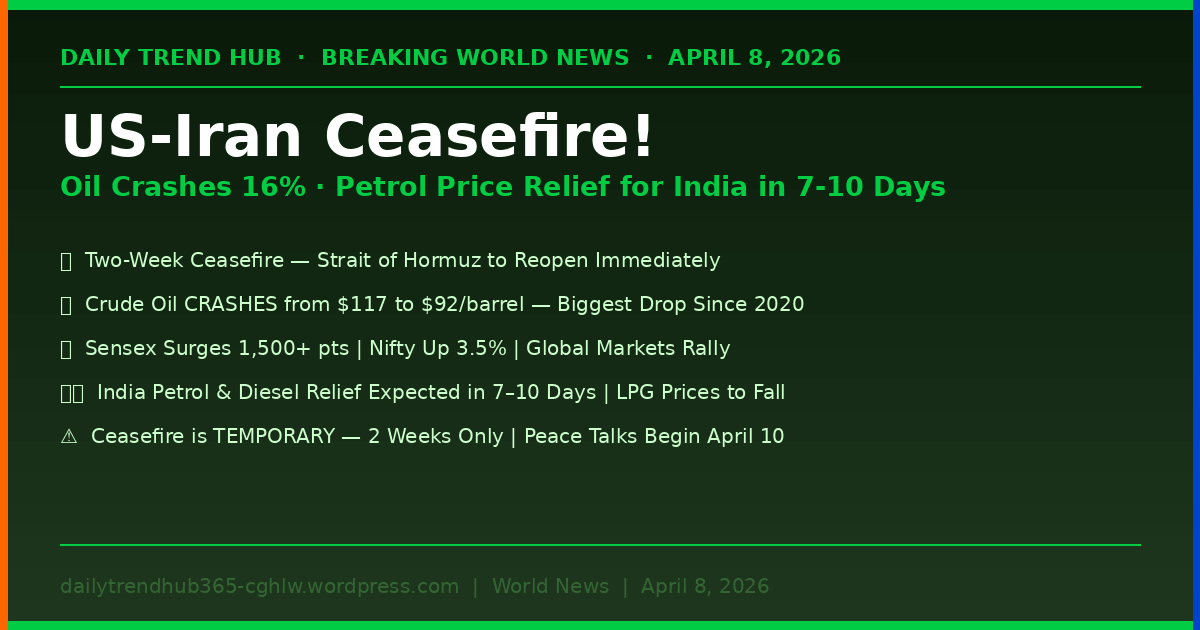
US-Iran Ceasefire LIVE: Oil Crashes 16%, Sensex Surges — What It Means for India’s Petrol, Diesel & LPG Prices
Strait of Hormuz to Reopen
Next Talks: April 10, 2026 in Islamabad | Condition: Complete & immediate opening of Strait of Hormuz
In a dramatic diplomatic breakthrough that shocked markets worldwide, US President Donald Trump announced a two-week ceasefire with Iran late Tuesday night — less than two hours before his self-imposed deadline to bomb Iranian power plants and bridges. Pakistan Prime Minister Shehbaz Sharif brokered the deal, asking Trump to delay his deadline to allow negotiations, while simultaneously requesting Iran reopen the Strait of Hormuz as a goodwill measure. The result? Oil crashed 16% overnight, global stock markets surged, and India woke up to the prospect of falling petrol, diesel and LPG prices within 7–10 days. Here is everything you need to know.
- What Exactly Happened — The Ceasefire Timeline
- Oil Crash Explained — Why Prices Fell 16% in Hours
- India’s Impact — Petrol, Diesel & LPG Price Relief
- Sensex & Nifty Surge — What Indian Investors Need to Know
- Risks & Caution — Why This Is Only a Temporary Pause
- Global Impact — US, Europe, Asia & Shipping
- What Happens Next — April 10 Talks in Islamabad
What Exactly Happened — The US-Iran Ceasefire Timeline
The ceasefire announcement on the night of April 7–8 was one of the most dramatic diplomatic moments since the war began over five weeks ago. Here is a chronological account of how it unfolded:
- March 2026: US and Israel launched military campaign against Iran. Iran closed the Strait of Hormuz — triggering the largest oil supply disruption in history. Crude oil surged from $67 to a peak of $126 per barrel.
- April 6–7: Trump issued a final ultimatum — reopen the Strait by 8 PM ET Tuesday or face attacks on Iranian power plants and bridges. Trump posted on Truth Social: “A whole civilization will die tonight, never to be brought back again.”
- April 7, ~6:00 PM ET: Pakistan PM Shehbaz Sharif called Trump and asked him to delay the deadline to allow last-minute negotiations. He simultaneously asked Iran to reopen the Strait as a goodwill gesture.
- April 7, ~6:10 PM ET: Trump announced on Truth Social: “We received a 10-point proposal from Iran, and believe it is a workable basis on which to negotiate.” A two-week ceasefire was agreed.
- April 7, Night: Iran’s Foreign Minister Araghchi confirmed: “For a period of two weeks, safe passage through the Strait of Hormuz will be possible via coordination with Iran’s Armed Forces.”
- April 8, Pre-Market: Oil crashed 16%. S&P 500 futures surged 2.7%, Nasdaq jumped 3.46%. Indian markets opened sharply higher with Nifty up 3.5%.
Oil Crashes 16% — Why Prices Fell So Sharply & What It Means
The oil price crash on April 8 was one of the largest single-day drops in crude oil prices in modern history. Here is a snapshot of the dramatic move:
| Benchmark | Price (Peak — April 7) | Price (April 8 Morning) | Change |
|---|---|---|---|
| WTI Crude (US) | $117/barrel | ~$92/barrel | ▼ -21.4% |
| Brent Crude (Global) | $126/barrel (March peak) | ~$91/barrel | ▼ -16–17% |
| Natural Gas Futures | High levels | Down ~5% | ▼ -5% |
| WTI vs Feb 27 (pre-war) | $67/barrel | ~$92/barrel | ▲ Still +37% above pre-war |
The crash occurred because markets priced in the war premium instantly reversing. With the Strait of Hormuz set to reopen, 187 tankers carrying 172 million barrels of stranded crude can now begin moving toward their destinations — flooding the market with previously blocked supply.
What the Ceasefire Means for India — Petrol, Diesel, LPG & Economy
India imports approximately 85% of its crude oil — making it one of the countries most directly affected by the Strait of Hormuz crisis. The ceasefire brings immediate hope of relief, though fuel price changes at Indian pumps will take some time to filter through.
| Area | Current Status | Expected Change Post-Ceasefire | Timeline |
|---|---|---|---|
| Petrol (Delhi) | ₹94.77/litre | Possible reduction of ₹2–5/litre if crude stays below $100 | 7–10 days |
| Diesel (Delhi) | ₹87.67/litre | Possible reduction of ₹2–4/litre | 7–10 days |
| LPG (Domestic Cylinder) | ₹912.50/cylinder | Price revision possible; LPG vessels already heading to India | 2–4 weeks |
| Indian Rupee (USD/INR) | ~₹94.70/USD | Rupee may strengthen slightly on lower oil import bill | Gradual |
| Sensex / Nifty | Nifty at ~22,700 | Strong upward move — Nifty up 3.5% on ceasefire news | Immediate |
| Inflation (CPI) | Elevated | Gradual easing if oil stays down — full impact in 4–6 weeks | 4–6 weeks |
India’s Ministry of External Affairs confirmed it has helped 1,862 Indian nationals exit Iran through Armenia and Azerbaijan, including 935 students and 472 fishermen. The MEA said it will continue monitoring the situation closely.
Sensex & Nifty Surge — What Indian Investors Should Know Today
Indian equity markets responded with a sharp rally to the ceasefire news. The Nifty 50 gained 3.5% in the first week of April even during peak war tensions — a sign that markets had partially been pricing in a ceasefire. The announcement delivered an additional sharp upward move.
| Sector | Ceasefire Impact | Stocks to Watch |
|---|---|---|
| Aviation & Airlines | Strong positive — jet fuel prices falling, routes normalising | IndiGo, Air India |
| Paints & Chemicals | Positive — key raw materials priced cheaper | Asian Paints, Berger |
| Fertilisers | Very positive — ammonia and urea supply chains reopening | Coromandel, Chambal |
| FMCG | Positive — logistics costs falling | HUL, ITC, Dabur |
| Oil Marketing Companies (OMCs) | Mixed — OMCs may benefit from narrowing under-recovery on LPG | BPCL, HPCL, IOC |
| Metals (Steel, Aluminium) | Slightly negative — commodity rally partially reverses | Tata Steel, Hindalco |
Why This Is Only Temporary — Key Risks That Could Reignite the Crisis
While the ceasefire is being celebrated as a major breakthrough, analysts and market experts are urging caution. Here are the key risks that could reverse the situation:
| Risk | Details | Probability |
|---|---|---|
| Ceasefire is Only 2 Weeks | Expires April 22, 2026. If peace talks in Islamabad fail, war could resume | High — talks face “significant hurdles” |
| Iran’s Transit Fees | Iran may charge $1–2 million per tanker for Hormuz passage — adding ~$1/barrel to oil costs permanently | Very likely |
| Israel Continuing in Lebanon | Israel confirmed it will keep fighting in Lebanon even during the US-Iran ceasefire | Ongoing — Lebanon war continues |
| Tanker Backlog | 187 tankers with 172 million barrels still stranded — clearing this won’t happen overnight | Takes weeks to normalise |
| Iran’s Political Position | Iran’s regime may have “solidified political control” from the crisis — incentive to maintain gatekeeper status over Hormuz | Structural long-term concern |
| Damaged Infrastructure | Gulf oil refineries, storage, and ports damaged by strikes — OPEC+ warns repair is “costly and takes a long time” | Months to fully recover |
Global Market Reaction — US, Europe, Asia & What the Strait Reopening Means
The ceasefire triggered one of the most dramatic simultaneous market rallies across multiple asset classes in recent years. Here is the global picture:
| Market / Region | Reaction |
|---|---|
| US Stock Futures (S&P 500) | +2.7% pre-market; Dow futures +1,100 pts (+2.5%); Nasdaq +3.46% |
| European Markets (FTSE 100) | FTSE 100 surged 248 points at open; miners and airlines led gains |
| Asian Markets (Japan Nikkei) | Surged Wednesday morning; South Korea’s Kospi +0.8%; Australia ASX +1.7% |
| India (Nifty 50) | +3.5% on ceasefire news; strong across financial, aviation, FMCG sectors |
| US Dollar | Fell — dollar weakened as safe-haven demand reduced; EUR rose to $1.1701 |
| Gold | +2.5% — paradoxically rose as markets priced in lower oil-driven inflation ahead |
| Shipping Stocks | Rallied — MarineTraffic confirmed Greek and Liberia-flagged vessels already transiting the Strait |
The Strait of Hormuz carries approximately 20% of the world’s daily oil supply. Its effective closure since early March 2026 was described by the IEA as the “greatest global energy security challenge in history” — surpassing even the 1970s oil crisis in terms of scale and speed of disruption.
April 10 Peace Talks in Islamabad — What Comes After the Ceasefire?
The two-week ceasefire is a temporary pause — not a permanent peace. The real test begins on April 10 in Islamabad, where US Vice President JD Vance is expected to meet Iranian Speaker Ghalibaf for formal negotiations.
According to four sources cited by Axios, the US, Iran, and regional mediators are discussing a possible 45-day extended ceasefire that could eventually lead to a permanent end to the war. Key sticking points include the status of Iran’s uranium enrichment programme (which Tehran calls a “red line”), the future of the Strait’s governance, and the withdrawal of US and Israeli forces from Iranian territory.
For India, the most critical near-term outcome is whether the Strait of Hormuz remains genuinely open for the next two weeks — allowing the 187 stranded tankers to clear their backlog and normalise oil supply to Asian markets. If this happens, petrol and diesel price revisions at Indian pumps could begin as early as April 14–15.
US-Iran Ceasefire — Key Facts (April 8, 2026)
- 🕊️ US and Iran agreed to a 2-week ceasefire — brokered by Pakistan PM Shehbaz Sharif on April 7 night.
- 🛢️ Crude oil crashed 16% — WTI fell from $117 to ~$92/barrel; Brent at ~$91/barrel.
- 📈 Global markets rallied — S&P 500 +2.7%, Nifty +3.5%, Nasdaq +3.46%, FTSE +248 pts.
- 🇮🇳 India petrol/diesel relief expected in 7–10 days if crude stays below $100/barrel.
- 🚢 Strait of Hormuz to reopen — 187 tankers with 172 million barrels of stranded oil can now move.
- ⚠️ Ceasefire expires April 22 — next peace talks in Islamabad on April 10.
- ⚠️ Iran may charge $1–2M transit fees per tanker — structural new cost for global shipping.
- 🇮🇳 India’s MEA helped 1,862 Indians exit Iran; advises remaining citizens to leave expeditiously.