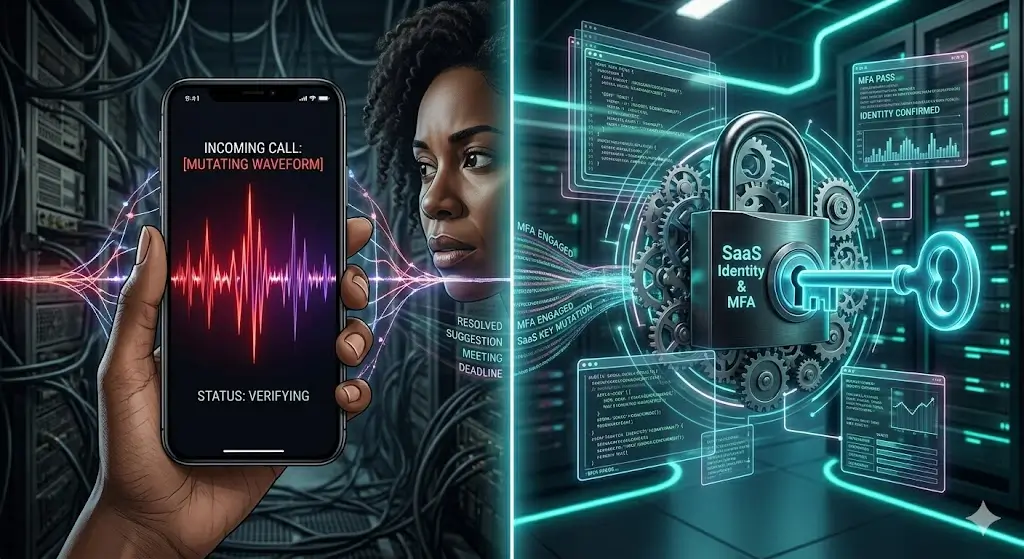
The SaaS Identity Crisis: How AI Voice Phishing (Vishing) Bypasses MFA
For years, cybersecurity compliance could be summed up in a simple mantra: Enable Multi-Factor Authentication (MFA), train your employees not to click weird links, and your data will be safe.
That era is officially over.
Security telemetry reveals an alarming tactical shift in the cybercrime landscape. As automated email filters have successfully neutralised up to 94% of traditional email phishing attempts, threat actors have completely pivoted their strategies. They are no longer typing out malicious emails; they are calling your employees on the phone using incredibly realistic, AI-cloned voices.
Welcome to the age of advanced Voice Phishing (Vishing) and the catastrophic SaaS Identity Crisis.
Understanding the Attack Vector: What is Vishing?
To properly defend an enterprise network, IT leaders must understand that this isn’t the classic “robocall” spam of the past.
Vishing (noun): A portmanteau of “voice” and “phishing,” representing a social engineering attack executed over phone calls or voice messages, increasingly weaponized via AI voice cloning to impersonate trusted authority figures.
Instead of targeting lower-level employees with bulk operations, modern vishers engage in highly targeted, interactive social engineering. They scour open-source intelligence—LinkedIn updates, public corporate directory structures, and recent conference speaker lists—to map an organization’s hierarchy.
Armed with less than thirty seconds of high-quality audio pulled from a public YouTube video or podcast, attackers use deepfake audio software to mimic a company executive or an IT Helpdesk technician in real time.
The SaaS Identity Crisis: Bypassing the Digital Gatekeeper
The core vulnerability isn’t necessarily a failure of human intelligence; it is an architectural flaw in how modern cloud networks manage user sessions. Cybercriminals use interactive voice manipulation to trick users into validating what security firms call Long-Lived OAuth Tokens and Session Cookies.
When an attacker calls an administrative employee pretending to be a panicked IT director experiencing a system crash, they don’t ask for a password. They instruct the user to click “approve” on an authentication push notification sent directly to their phone, or to read aloud a one-time token.
[Attacker via Cloned Voice] ➔ Call Employee ➔ "I'm pushing an IT override ticket to your device now, please hit accept."
[Employee] ➔ Clicks MFA Prompt ➔ Validates malicious login session.
[Attacker System] ➔ Harvests OAuth token ➔ Establishes persistent, unmonitored cloud access.
Once that token is intercepted, the attacker completely bypasses the traditional login screen. They effectively inherit the employee’s exact digital identity inside critical SaaS platforms like Microsoft 365, Salesforce, or AWS—rendering traditional static firewall parameters entirely useless.
The Architecture of a Modern Enterprise Vishing Attack
Understanding the exact anatomy of how an exploit breaks down reveals precisely where defense structures fail. The timeline from initial call to full cloud infrastructure compromise moves with terrifying speed.
Anatomy of an AI-Powered Vishing Intrustion
Transitioning From Static to Behavioral Defenses
Because interactive AI voice clones smoothly bypass traditional technical filters, the modern enterprise must rethink its defense frameworks. Security can no longer rely purely on perimeter defenses. Instead, organization leaders must transition to Continuous Identity Verification and strict behavioral analysis.
| Legacy Security Approach | The Modern Behavioral Standard |
| Static IOCs: Relying entirely on lists of known malicious IP addresses or blacklisted file hashes. | Anomaly Detection: Flagging unexpected bulk API requests or concurrent logins from geographically impossible locations. |
| One-Time MFA: Granting total trust to a user the absolute moment they pass their initial morning login check. | Least Privilege Access: Enforcing continuous validation triggers whenever a user attempts to access sensitive Tier-0 corporate data assets. |
| Basic Phishing Training: Simulating fake, generic spam emails once a quarter to satisfy basic compliance requirements. | Out-of-Band Verification: Mandating that any verbal request regarding credential changes must be verified through an entirely separate communication channel. |
The Golden Rule of Out-of-Band Security: If an executive or IT technician calls you with an urgent, out-of-the-ordinary request involving access credentials, hang up immediately. Manually type out their verified Slack or internal message address and ask: “Did you just call me?”
Future-Proofing Your Enterprise Against the Vishing Wave
The threat profile is evolving rapidly. As cybersecurity defenses adapt, the gap between vulnerability discovery and weaponized exploitation has compressed into a matter of days.
Relying on standard, out-of-the-box security policies guarantees an eventual breach. To successfully protect intellectual property and private consumer data, organizations must view security not as a static IT checkbox, but as an active, constantly adapting human system.
By building clear out-of-band communication protocols, strictly locking down critical cloud control planes, and training teams to look for behavioral inconsistencies rather than perfect audio tones, businesses can safely navigate the complex realities of the ongoing agentic era.