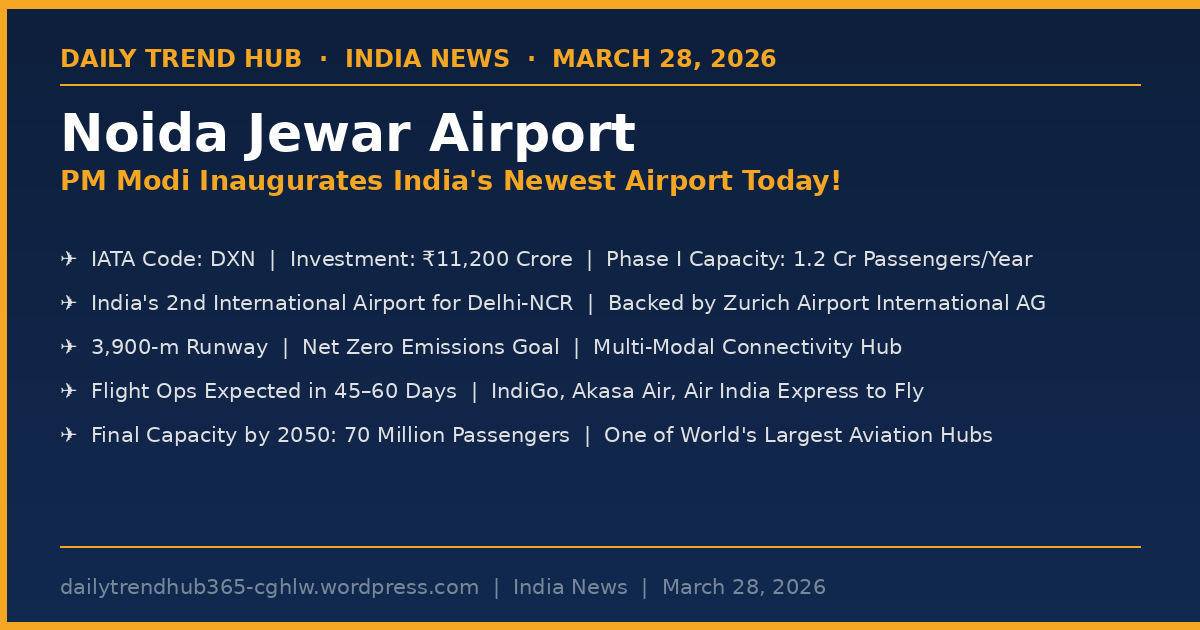
Noida Jewar Airport Inaugurated by PM Modi: India Gets Its Newest International Airport Today
Prime Minister Narendra Modi today inaugurated Phase I of the Noida International Airport (IATA: DXN) at Jewar, Gautam Buddha Nagar — officially giving India a brand-new international airport and Delhi-NCR its much-needed second air gateway. Built at a cost of ₹11,200 crore under a PPP model with Switzerland’s Zurich Airport International AG, the airport is designed to handle 1.2 crore (12 million) passengers per year in Phase I, eventually scaling to 70 million passengers by 2050. Here is everything you need to know about Noida Jewar Airport — from its world-class features and connectivity to its phase-wise expansion and what it means for travellers across UP and NCR.
Noida Jewar Airport — Overview & Background
The Noida International Airport, popularly called Jewar Airport after its location in Jewar town of Gautam Buddha Nagar district, Uttar Pradesh, is a greenfield airport project that was first proposed in 2001 but faced years of delays and political hurdles. The foundation stone was laid by PM Modi on November 25, 2021, and Phase I was completed in approximately four years.
The airport is developed by Noida International Airport Limited (NIAL) through a Public-Private Partnership, with Flughafen Zürich AG (Zurich Airport International AG) winning the 40-year concession bid in 2019. Civil construction was awarded to Tata Projects Limited in 2022.
The airport has been granted an aerodrome licence for public use by DGCA and cleared by BCAS on the security front. It has been formally designated as the second international airport for Delhi-NCR, complementing Indira Gandhi International Airport which handles over 70 million passengers a year and has long been operating at saturation.
World-Class Features & Heritage-Inspired Design of Jewar Airport
The Noida International Airport has been designed as a sustainable, future-ready, and culturally rooted infrastructure project. Its architecture draws deep inspiration from Indian heritage, with the terminal’s sweeping roof canopy shaped to mimic the flow of the rivers Yamuna, Ganga, and Hindon, while the interiors feature traditional red stone and intricate jali (lattice) work for natural ventilation and lighting.
| Feature | Details |
|---|---|
| Terminal Building | T1 — 1,00,000 sq. m. area, domestic & international passengers |
| Runway | 3,900-metre runway, capable of handling wide-body aircraft |
| Navigation Systems | ILS (Instrument Landing System) + advanced airfield lighting for all-weather, 24×7 operations |
| Cargo Hub | Multi-Modal Cargo Hub with Integrated Cargo Terminal — 2.5 lakh metric tonnes/year (expandable to 18 lakh MT) |
| MRO Facility | Dedicated 40-acre Maintenance, Repair & Overhaul facility |
| Sustainability | India’s first Net Zero Emissions airport — renewable energy, low-carbon materials |
| Fuel Advantage | ATF VAT of just 4% in UP vs 25% in Delhi — cheaper for airlines to operate |
How to Reach Jewar Airport — Road, Metro, Rail & Airline Connectivity
Noida International Airport has been planned as a multi-modal transport hub, with seamless integration across road, metro, rail, and rapid transit systems. This is a major advantage over many Indian airports that suffer from poor last-mile connectivity.
| Mode | Connectivity Details |
|---|---|
| Road | Direct access via Yamuna Expressway, connecting Noida, Greater Noida, Agra, and Mathura |
| Metro | Planned integration with Delhi Metro extension to Jewar |
| High-Speed Rail | Upcoming Delhi–Varanasi High-Speed Rail to pass through airport |
| RRTS | Ghaziabad–Jewar RRTS: 71.1 km rapid rail, 11 stations — to be completed by 2031 |
| Railway | Palwal–Noida Airport–Khurja Railway (PNAKR): 61 km line under construction connecting airport to two major rail corridors |
Noida Jewar Airport Phase-Wise Expansion — From 12 Million to 70 Million Passengers
The Noida International Airport has a master plan covering four phases of development, with completion targeted by 2050. At full build-out, it will be one of the largest airports in the world.
| Phase | Terminal | Capacity | Runways | Investment | Timeline |
|---|---|---|---|---|---|
| Phase I ✅ (Today) | T1 | 12 MPPA | 1 | ₹11,200 Cr | 2026–27 |
| Phase II | T2 | 30 MPPA | 2 | ₹5,983 Cr | 2031–32 |
| Phase III | T3 | 50 MPPA | 4 | ₹8,415 Cr | 2036–37 |
| Phase IV | T4 | 70 MPPA | 6 | ₹10,575 Cr | by 2050 |
The total planned investment across all four phases is approximately ₹29,561 crore. Upon full completion, Noida International Airport will feature six runways and four terminals, with the potential to handle up to 70–120 million passengers annually.
Economic Impact — Jobs, UP’s GDP & India’s Aerotropolis Vision
The Noida International Airport is being branded as India’s first “Aerotropolis” — an integrated airport city that combines aviation infrastructure with logistics hubs, business zones, hospitality, retail, and residential development. Chief Minister Yogi Adityanath has stated the airport is expected to contribute to over 1% growth in Uttar Pradesh’s GDP, acting as a strategic engine for UP’s ambition to become a $1 trillion economy.
The airport is expected to generate thousands of direct and indirect jobs in aviation, hospitality, logistics, ground handling, retail, and construction — bringing significant economic opportunity to Jewar, Mathura, Agra, and surrounding districts.
The airport’s 4% VAT on Aviation Turbine Fuel in Uttar Pradesh (compared to 25% in Delhi) also gives airlines a strong cost incentive to base more operations at Jewar — which could eventually translate into more competitive airfares for passengers.
When Will Flights Start from Jewar? Airlines & Expected Routes
Although PM Modi has inaugurated Phase I today, commercial flight operations are not expected to begin immediately. According to official sources, flights are expected to commence within 45 to 60 days of today’s inauguration — meaning the first flights from Noida Jewar Airport could take off as early as mid-May 2026.
Initial services are expected to focus on domestic routes, with international operations following once airline schedules and regulatory approvals are fully in place. The following airlines are expected to launch services from Jewar Airport:
| Airline | Expected Focus |
|---|---|
| IndiGo | Lead carrier for domestic connectivity — Mumbai, Bengaluru, Hyderabad, Chennai, Kolkata |
| Akasa Air | Strategic network expansion from Jewar as a new hub |
| Air India Express | Domestic and short-haul international — especially Gulf routes |
Noida Jewar Airport — Quick Summary (March 28, 2026)
- PM Modi inaugurated Phase I of Noida International Airport (IATA: DXN) at Jewar today at 12 noon.
- Built at ₹11,200 crore under PPP with Zurich Airport International AG — one of India’s largest aviation investments.
- Phase I capacity: 12 million passengers/year; runway length: 3,900 metres for wide-body aircraft.
- India’s first Net Zero Emissions airport — features sustainable energy and traditional architectural design.
- Multi-modal connectivity: Yamuna Expressway, Delhi Metro, RRTS, High-Speed Rail, and two railway lines planned.
- Flights expected to begin in 45–60 days — IndiGo, Akasa Air, and Air India Express to launch services.
- Full airport to handle 70 million passengers/year by 2050 across four phases and six runways.