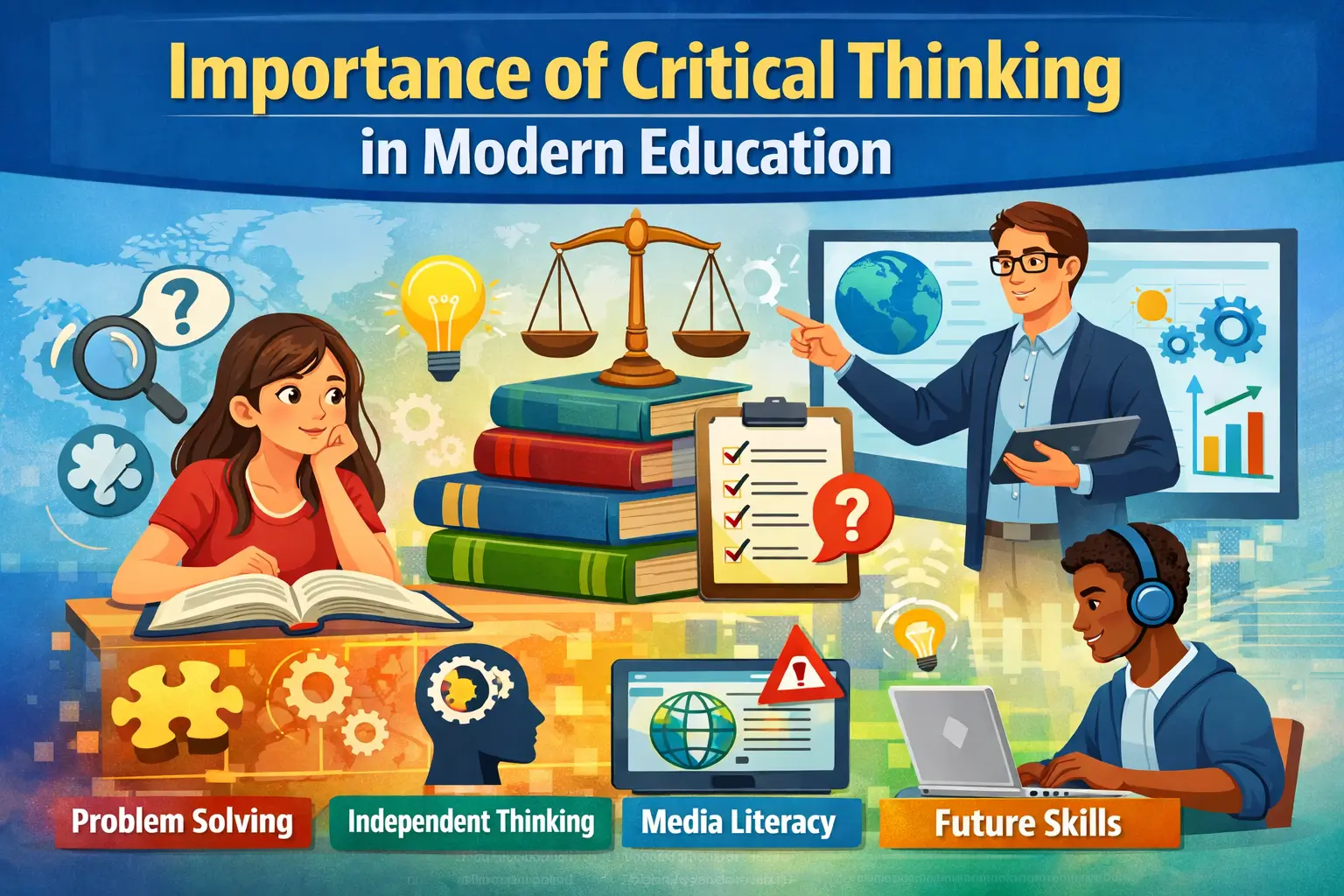
The Importance of Critical Thinking in Modern Education ||critical thinking in education

Critical Thinking in  Education

Introduction
Education today is evolving beyond traditional memorization and exam-based learning. In the past, many education systems focused mainly on remembering facts, formulas, and theories. While knowledge is still important, modern education places greater emphasis on developing practical skills that help students succeed in real-world situations.

One of the most important skills students must develop is critical thinking. This ability allows learners to analyze information, question assumptions, and make logical decisions. Instead of simply accepting information as true, critical thinkers evaluate ideas carefully and form their own conclusions based on evidence.

In today’s digital world, students are constantly exposed to large amounts of information through the internet, social media, and digital platforms. Because of this, the ability to think critically has become more important than ever. It helps students separate reliable information from misinformation and develop a deeper understanding of complex topics.

What Is Critical Thinking?
Critical thinking is the ability to evaluate information carefully, analyze arguments, and make reasoned judgments. It involves thinking logically, asking questions, and considering different viewpoints before forming an opinion.

Rather than accepting facts at face value, critical thinkers explore the reasons behind ideas and examine the evidence that supports them. They are curious, analytical, and open to new perspectives.

Students who develop critical thinking skills often ask important questions such as:

Is this information reliable?
What evidence supports this claim?
Are there alternative viewpoints or interpretations?
What are the possible consequences of this decision?
By asking such questions, students learn to explore topics more deeply and gain a better understanding of the world around them. This ability encourages intellectual curiosity and strengthens learning.

Critical Thinking in  Education

Why Critical Thinking Is Important in Education
1. Improves Problem-Solving Skills
One of the main benefits of critical thinking is improved problem-solving ability. Students who think critically can identify problems clearly and analyze possible solutions. Instead of relying on memorized answers, they learn to examine situations carefully and make informed decisions.

Problem-solving is an essential skill not only in academic settings but also in everyday life. Whether solving a mathematical problem, conducting scientific research, or making personal decisions, critical thinking helps students approach challenges logically and confidently.

2. Encourages Independent Learning
Critical thinking also promotes independent learning. Students who think critically do not rely solely on teachers or textbooks for knowledge. Instead, they learn how to research information, evaluate sources, and develop their own opinions.

Independent learners are more motivated and curious. They actively seek new knowledge and explore different perspectives on various topics. This ability helps students become lifelong learners who continue to grow and learn even after completing their formal education.

3. Helps Students Avoid Misinformation
In the digital age, students are surrounded by information from websites, social media platforms, and online communities. While this access to information can be beneficial, it also increases the risk of encountering false or misleading content.

Critical thinking allows students to evaluate the credibility of sources and recognize biased or inaccurate information. By analyzing evidence and questioning claims, students can make informed judgments and avoid spreading misinformation.

This skill is especially important today because the ability to evaluate information responsibly is essential for responsible citizenship and informed decision-making.

4. Promotes Creativity and Innovation
Critical thinking is closely connected to creativity. When students question ideas and explore different perspectives, they often discover new possibilities and innovative solutions.

Creative thinking encourages students to go beyond traditional approaches and develop unique ideas. In fields such as science, technology, engineering, and business, innovation often begins with critical thinking and curiosity.

By encouraging students to explore ideas independently, education systems can foster creativity and prepare learners to contribute to new discoveries and advancements.

5. Prepares Students for Future Careers
Employers in today’s job market value individuals who can analyze situations, evaluate information, and solve complex problems. Critical thinking helps students develop these abilities, making them better prepared for professional challenges.

In many careers, employees must make decisions based on data, collaborate with others, and adapt to changing circumstances. Critical thinking enables individuals to approach these tasks effectively and confidently.

As industries continue to evolve and new technologies emerge, the demand for critical thinking skills will only increase.

How Schools Can Develop Critical Thinking Skills
Educational institutions play a vital role in helping students develop critical thinking abilities. Teachers can create learning environments that encourage questioning, discussion, and exploration.

Some effective strategies include:

Inquiry-based learning: Encouraging students to ask questions and investigate answers independently.
Group discussions and debates: Allowing students to hear different viewpoints and develop their own arguments.
Project-based learning: Engaging students in solving real-world problems through research and collaboration.
Case studies: Analyzing real-life situations to develop logical reasoning and decision-making skills.
These teaching methods help students move beyond passive learning and become active participants in the educational process.

Role of Teachers and Technology
Teachers play a crucial role in guiding students to think critically. Instead of simply delivering information, effective teachers encourage students to analyze ideas, question assumptions, and explore different perspectives.

Technology can also support critical thinking by providing access to global information, interactive learning platforms, and digital collaboration tools. Online resources allow students to explore topics in depth and connect with learners from around the world.

However, while technology offers many advantages, students must still develop the ability to evaluate digital information carefully. Teachers must guide students in using technology responsibly and critically.

Conclusion
Critical thinking is a vital skill in modern education. It helps students analyze information, solve problems effectively, and make thoughtful decisions in both academic and real-life situations.

As the world becomes increasingly complex and information-driven, the ability to think critically will remain essential for success. Schools, teachers, and educational systems must prioritize the development of critical thinking skills to prepare students for the challenges of the future.

By encouraging curiosity, analysis, and independent thought, modern education can help students become confident learners, responsible citizens, and innovative problem solvers.

The Role of Technology in Modern Education: Benefits, Challenges, and Future Impact

Leave a Comment