World News Digest: 5 Biggest Stories Shaping the Globe Today
Saturday, March 21 marks Day 22 of the U.S.–Israel war on Iran — and the world is watching closely as oil prices hit $112 a barrel, Iranian drones attack Gulf oil infrastructure, and Washington debates whether to “wind down” or escalate. From a record-breaking heat wave across the United States to an ongoing power crisis in Cuba and fresh fighting in Lebanon, here is your complete Saturday news briefing from Daily Trend Hub.
world news today March 21 2026
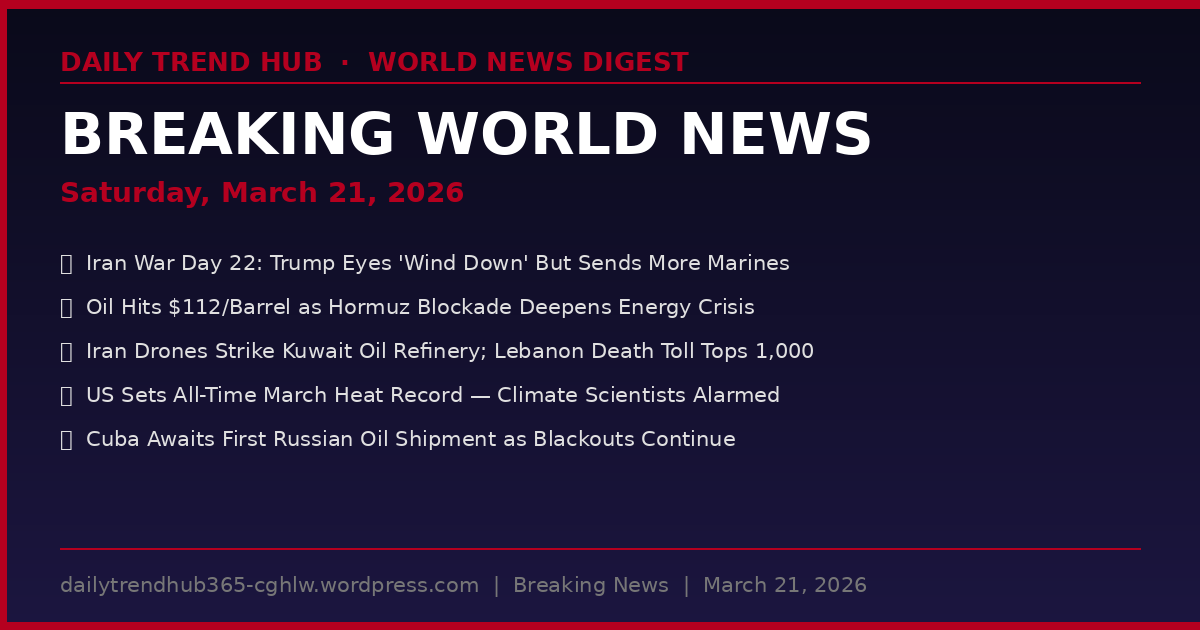
- Iran War Day 22: Trump Eyes ‘Wind Down’ but Sends More Marines
- Oil at $112/Barrel — Hormuz Blockade Triggers Global Energy Crisis
- Lebanon Death Toll Tops 1,000 as Iran Drones Strike Kuwait Refinery
- U.S. Breaks All-Time March Heat Record — Climate Scientists Sound Alarm
- Cuba Awaits First Russian Oil Shipment as Island-Wide Blackouts Continue
Iran War Day 22: Trump Eyes ‘Wind Down’ but Sends More Marines to the Middle East
As the U.S.–Israel war with Iran entered its 22nd day on Saturday, President Donald Trump signalled that the administration is considering “winding down” military efforts — even as the Pentagon confirmed that thousands more U.S. Marines are being deployed to the Persian Gulf region.
The USS Boxer group of three ships carrying Marines from the 11th Marine Expeditionary Unit has left California and is expected to reach the Persian Gulf in approximately three weeks. The contradictory signals — peace rhetoric paired with military reinforcement — have confused allies and drawn sharp criticism at home. U.S. Ambassador to the United Nations Mike Waltz told CNN that Trump is “a president of peace” seeking to “end wars,” but acknowledged the Iranian regime has been at war with the United States for nearly 50 years.
To ease the energy supply shock, the Trump administration has lifted U.S. sanctions on Iranian oil currently loaded on ships at sea — a temporary measure lasting until April 19, 2026. The White House has already lifted some sanctions on Russian crude to bring more barrels to market. Goldman Sachs has warned that elevated oil prices could persist through 2027 if the Strait of Hormuz remains blocked.
A CNN town hall hosted by Dana Bash in New York on Friday brought together experts and a live audience to assess the war’s trajectory. Former officials warned of “a whole new level of escalation” should U.S. troops be deployed inside Iran — a decision Trump says he has not yet made but has not ruled out.
Oil Hits $112 a Barrel — Hormuz Blockade Triggers Worst Global Energy Crisis in Years
Crude oil prices climbed to $112 a barrel on Friday — up roughly 45% since the start of the conflict — as the Strait of Hormuz, through which about one-fifth of the world’s oil and liquefied natural gas normally passes, remained largely closed to commercial traffic.
Several largely European nations issued a joint statement condemning Iran’s attacks on commercial vessels in the Gulf, calling the effective closure of the Strait “unacceptable.” The Kingdom of Bahrain subsequently joined the statement. The countries said they are ready to contribute to “appropriate efforts to ensure safe passage” but stopped short of military commitments.
U.S. gasoline prices have risen sharply in recent weeks, and Trump administration officials now privately estimate that higher prices could linger for months regardless of how soon military operations conclude. The administration has exhausted most of its standard policy levers for alleviating the supply shock, according to people familiar with internal discussions.
Lebanon Death Toll Tops 1,000; Iranian Drones Strike Kuwait’s Mina Al-Ahmadi Oil Refinery
Since Israeli attacks on Lebanon escalated on March 2, the death toll has surpassed 1,000 people, with at least 2,584 wounded, according to Lebanese health authorities. Nearly one in five people in Lebanon have been forced from their homes as Israel expands ground troop operations in the south of the country.
Fierce fighting continues in southern Lebanon. Hezbollah has claimed responsibility for multiple attacks, including missile strikes against Israeli soldiers in al-Aadaissah, Meiss el-Jabal, and Maroun al-Ras. Lebanese President Joseph Aoun has renewed calls for a ceasefire and negotiations with Israel, urging President Trump to intervene — calling him “more than anyone else” capable of ending the war in the Middle East.
Residents in Lebanese towns including Machghara and Sahmar reported receiving threatening phone calls from foreign numbers urging them to evacuate — raising fears of further Israeli military action in the Bekaa Valley. In Tehran, streets have been largely deserted, with paramilitary officials and vigilantes banning gatherings for Nowruz celebrations, according to accounts shared with NPR.
United States Shatters All-Time March Heat Record — Experts Confirm It Is Climate Change
The United States broke its all-time heat record for the month of March this week, with temperatures in multiple regions surging to levels never before recorded in the month’s history. Scientists and meteorologists confirmed the event is directly attributable to climate change, as carbon dioxide levels in the atmosphere reach the highest levels humans have ever experienced.
A rare fireball spotted over the eastern United States caused a sonic boom, coinciding with the heat event and drawing widespread attention on social media. Separately, new research published this week found that carbon dioxide at current concentrations could be measurably altering human blood chemistry — a finding described as “alarming” by the researchers involved.
A multi-year megadrought across the western United States has already claimed populations of wild plants, though scientists at a California site discovered that some species of scarlet monkeyflower — normally unable to survive days without water — had adapted to survive intense drought, offering a rare note of resilience amid otherwise grim findings.
Cuba Awaits First Russian Oil Shipment as Island-Wide Blackouts Enter Third Week
Cuba is preparing to receive its first shipment of Russian oil in 2026, just days after officials announced the government was running power generation entirely on natural gas, solar power, and thermoelectric plants as severe island-wide blackouts entered their third week.
The country’s electrical grid suffered a complete disconnection earlier this month affecting all 11 million residents, triggered by a months-long fuel shortage. With the anticipated Russian oil shipment, authorities hope to restore more stable electricity supply — though the island’s ageing infrastructure and ongoing economic crisis make a quick recovery uncertain.
President Trump reiterated his intention to “free” Cuba, with analysts interpreting his remarks as part of a broader effort to pressure Havana’s leadership. A second person also died in U.S. ICE custody this week, adding to domestic political tensions over immigration enforcement policy.
Today’s Key Takeaways — March 21, 2026
- Trump signals a possible “wind down” of the Iran war on Day 22, even as thousands more U.S. Marines head to the Persian Gulf.
- Crude oil prices hit $112 a barrel; Goldman Sachs warns elevated prices may last through 2027.
- Iran’s Ali Larijani confirmed killed; Israel strikes Tehran on Nowruz; Iranian drones hit Kuwait’s Mina Al-Ahmadi refinery.
- Lebanon’s death toll surpasses 1,000 since early March; nearly 1-in-5 residents displaced.
- The U.S. shatters its all-time March heat record — scientists confirm climate change as the driver.
- Cuba’s first Russian oil shipment expected as island-wide blackouts stretch into their third week.