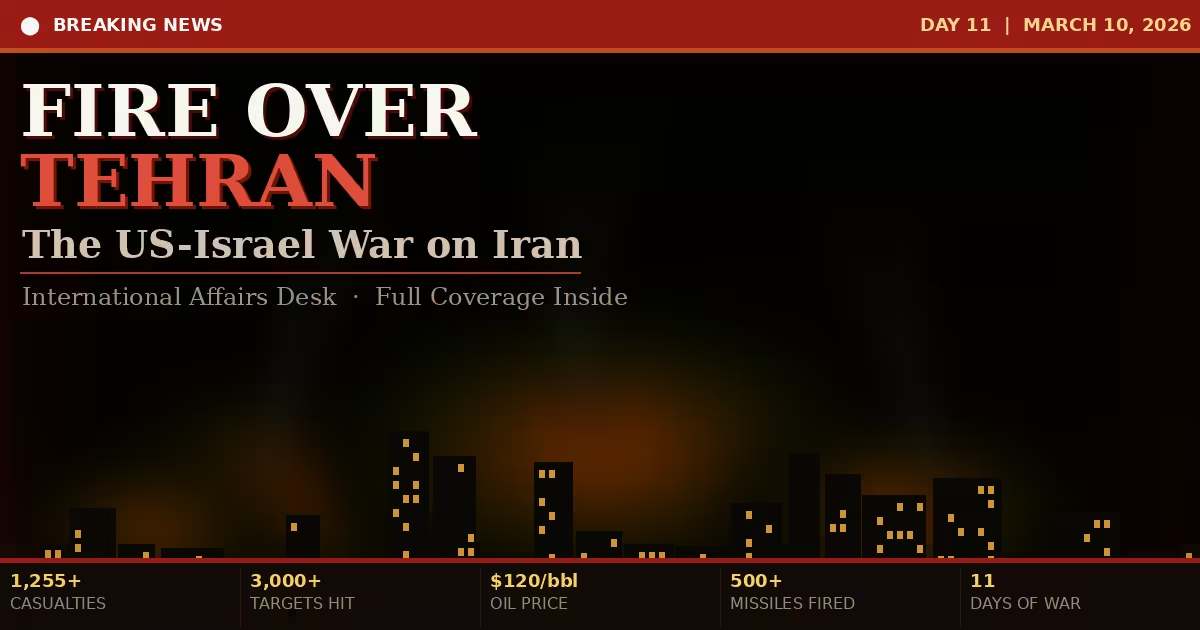
US Israel Iran war 2026
Fire Over Tehran:
The US-Israel War on Iran
A Region in Flames — How a Calculated Strike Ignited the Middle East’s Most Dangerous Conflict in Decades
On the morning of February 28, 2026, the world woke to a transformed Middle East. In the pre-dawn darkness, a coordinated wave of American and Israeli missiles streaked toward targets across Iran — striking military compounds, nuclear facilities, government buildings, and the residence of the Islamic Republic’s supreme leader. What followed was not a surgical strike or a warning shot. It was the opening salvo of a full-scale war — one that has reshaped the geopolitical landscape of the region and sent shockwaves across global financial markets.
US Israel Iran war 2026
Feb 28
US-Israeli joint strikes begin. Supreme Leader Khamenei killed. Tehran, Isfahan, Qom, and Karaj targeted.
Mar 1
Iran retaliates with missiles on Israel and US bases. 9 Israeli civilians killed in Beit Shemesh. First US soldier killed.
Mar 5
Iran reports 500+ missiles and ~2,000 drones launched. Strait of Hormuz threatened. Oil hits $120/barrel.
Mar 9
Iran names Mojtaba Khamenei new Supreme Leader. Lebanon displacement reaches 700,000.
Mar 10
Day 11. US warns of most intense strikes yet. 40 killed overnight in Tehran residential attack.
Section 01
The Opening Strike: How It Began
The joint US-Israeli assault commenced simultaneously across multiple Iranian cities — Tehran, Isfahan, Qom, Karaj, and Kermanshah. The compound of Iran’s Supreme Leader Ayatollah Ali Khamenei was among the first targets hit. Iranian state media confirmed the following morning that Khamenei had been killed — along with members of his immediate family.
Both Washington and Jerusalem had grown increasingly alarmed following the collapse of indirect nuclear negotiations in February 2026, in which Oman had served as intermediary. US President Donald Trump declared he was “not thrilled” with the pace of talks — a signal that alternative options were being actively considered.
The conditions had been building for years. Israeli campaigns from 2023 had weakened Iran’s proxies. A Twelve-Day War in June 2025 had seen US airstrikes target Iran’s nuclear facilities. And in January 2026, Iran’s government violently suppressed mass protests — killing thousands — further eroding its legitimacy.
Section 02
Iran’s Response: Missiles, Drones, and Defiance
Iran did not hesitate. Within hours, Tehran launched hundreds of ballistic missiles and drones across the region. Israel bore the brunt, with missiles striking Beit Shemesh and killing nine civilians on March 1. Iranian strikes also targeted US installations in Qatar, Bahrain, Kuwait, Iraq, Jordan, Saudi Arabia, Turkey, and the UAE.
The war will only end through economic pain. We will continue fighting as long as necessary.
— Kamal Kharazi, Senior Iranian Official
By March 5, Iran’s IRGC reported 500+ missiles and nearly 2,000 drones launched — 40% at Israel, 60% at US targets. Iran moved to close the Strait of Hormuz and struck oil facilities, sending crude prices toward $120/barrel. Hezbollah resumed attacks from Lebanon, displacing nearly 700,000 people.
Section 03
A New Supreme Leader: The Khamenei Dynasty Continues
On March 9, Iran named Mojtaba Khamenei, 56, son of the slain Supreme Leader, as his successor. The appointment signals continuity — Mojtaba has deep IRGC ties and hard-line views. Hundreds of thousands rallied in Tehran in support. Russian President Putin wrote reiterating Moscow’s backing. Trump called it “a big mistake.”
Section 04
The Human Cost: Casualties and Civilian Suffering
Iran reports 1,255+ killed and ~10,000 injured as of March 10. The WHO has identified at least 13 Iranian health sites struck. Over 6,668 civilian units — including schools, hospitals, and heritage sites — have been hit per the Iranian Red Crescent.
UN human rights experts have characterised certain strikes — including the targeting of Khamenei’s family compound — as potential war crimes under the Rome Statute. The use of “double-tap” airstrikes has drawn widespread condemnation.
In Lebanon, 486 have been killed in renewed Israeli operations including 83 children. In Israel, 11 civilians confirmed dead from Iranian strikes. Eight US soldiers killed — the latest being Sgt. Benjamin N. Pennington, 26, of Kentucky, at Prince Sultan Air Base on March 1.
Section 05
Global Shockwaves: Energy, Markets, and Diplomacy
Oil near $120/barrel represents the largest oil disruption in history per the IMF. Chief Kristalina Georgieva warned policymakers to “prepare for the unthinkable.” US gas prices rose ~17%. G7 finance ministers convened to discuss strategic oil reserve releases.
The UK, France, and Germany condemned Iranian counter-strikes but oppose regime change. UK PM Keir Starmer stated he “does not believe in regime change from the skies.” NATO air defences in Turkey intercepted an Iranian ballistic missile — the second such intercept of the conflict.
Section 06
Day 11 and Beyond: No End in Sight
US Defence Secretary Pete Hegseth warned March 10 will be the most intense day of strikes yet. US forces have struck over 3,000 Iranian targets. Iran’s IRGC disputes claims its missile programme has been destroyed, insisting it deploys weapons in growing numbers with warheads exceeding one tonne.
An overnight strike on an eastern Tehran residential building killed at least 40. Iran’s parliament speaker vowed a “harsh response.” Trump described the campaign as “very far ahead of schedule” — assertions Iran’s military vigorously disputes.
What began as a calculated gamble has evolved into a multi-front regional war with no clear endgame. The fires burning over Tehran reflect decades of strategic tension.
— International Affairs Analysis, March 2026